
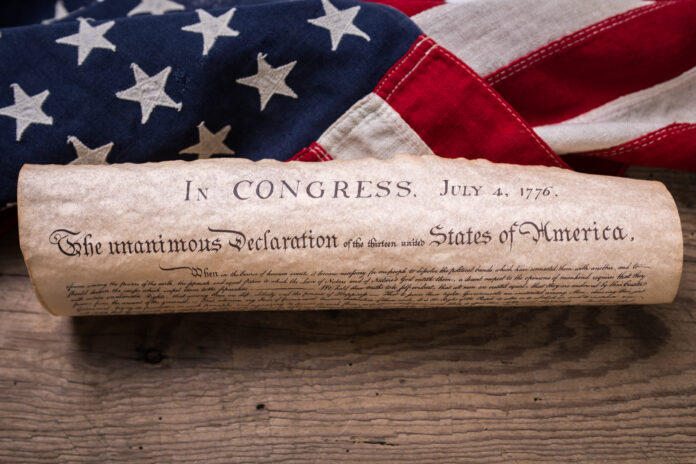
Two hundred and fifty years ago, the inhabitants of thirteen colonies in the Americas did an incredible thing: they declared themselves independent of an unjust government.
Their representatives drew up a declaration to document the reasons for their extraordinary action, and to inspire the people to make the sacrifices that would be necessary to win freedom.
Life, Liberty and the Pursuit of Happiness
They stated that all men were created equal, and that the purpose of a government was to secure the right to life, liberty and the pursuit of happiness. That the government should derive its just powers from the consent of the governed. That a new government should be instituted with the foundation of those principles and its powers organized as to seem most likely to affect their safety and happiness.
All the signers subscribed to the idea that government existed for the people; people did not exist for the government. Government did not give the people life and liberty; the people had an inherent right to life and liberty that could not be alienated by government. The people did not have an inherent right to happiness, but the people had an inalienable right to pursue their own happiness.
The Committee of Five
The Declaration of Independence was originally drafted by the Committee of Five. They were a mix of youthful idealism and seasoned statesmanship:
Robert R. Livingston: 29
Thomas Jefferson: 33
John Adams: 40
Roger Sherman: 55
Benjamin Franklin: 70
No one was disqualified for being too young or too old. The 56 delegates that signed the Declaration were the same mix, with an average age of 44. Many of them had property, families, businesses and reputations. All of them put their lives on the line for an ideal.
The Grievances That Led to Independence
We don’t have to imagine the unjust actions that had taken place to move the people in the Colonies to declare independence, because the Declaration sets forth a list of grievances that had been committed by the King and Country. There is a common theme: the British attitude was that the people, and specifically the people of the Americas, existed for the British government. The government did not exist for the people.
The people of the Colonies had not been quick to action. They first tried letters, entreaties, appeals and boycotts, and only when those efforts failed did they authorize the writing of the Declaration and a war.
A Declaration, Not the Beginning of the Conflict
Thomas Jefferson’s first draft of the Declaration was harsher than the final version passed Congress. His description of the King’s unjust actions and the people’s unsuccessful efforts to address and mitigate them is riveting.
By the time the Declaration was drafted, the King was already at war with the people of the Colonies. Their rebellion against his edicts had led him to hire mercenaries from on and off the continent. The people of the Colonies had to fight from all sides. No place was safe from the King’s imposed violence, theft and mayhem.
The Declaration of Independence did not create the conflict; it served to set forth the justification for the people’s refusal to capitulate and the goal for their new government.
Remembering What Was Sacrificed
When you speak your thoughts freely, enjoy the fruits of your labor, worship in your chosen religion, raise your children without government interference, vote, and act without repression, remember that there were people who lived and died to make that possible. Our thanks to them is evident every time we realize anew that we do not exist for our government – our government exists for us.
Hammerle Morris is Here to Help
At Hammerle Morris Law Firm, we understand that protecting your rights, your family and your future often starts with informed legal guidance. If you have questions about estate planning, probate, guardianship, business matters, litigation or planning for the years ahead, contact our team for guidance.
Virginia Hammerle is a licensed Texas attorney whose practice includes estate planning, probate, guardianship and litigation.
This article is for informational purposes only and does not constitute legal advice.